

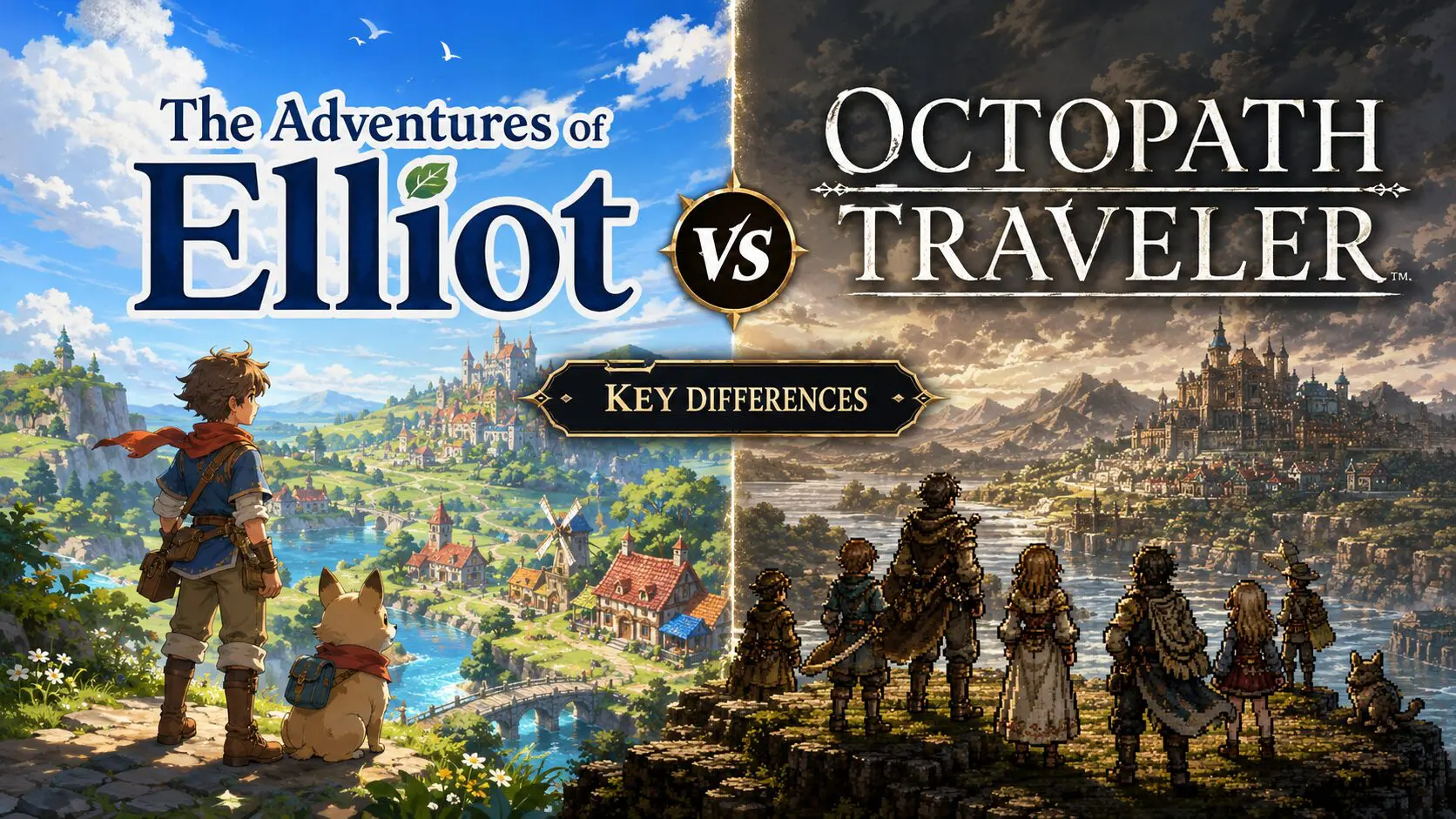
With The Adventures of Elliot having been recently released, gamers are starting to compare The Adventures of Elliot vs Octopath Traveler, whether Square Enix wants them to or not. To be fair, it shouldn’t really come as a surprise; the similarities are clear to see.
At first glance, The Adventures of Elliot doesn’t do much to separate itself from Octopath Traveler. It has a similar HD-2D design, albeit much more polished and modern than Octopath Traveler. As well as the same old-school charm that makes both games stand out. In fact, put a screenshot of it in front of most RPG fans, and plenty of them would probably say, “Oh, is this the new Octopath thing?”
Yes, it’s clear that in a brief comparison of The Adventures of Elliot vs Octopath Traveler, there are some similarities; the games clearly share some DNA, but it is not trying to be Octopath Traveler 3. The more you look at it, the more it feels like Square Enix is taking a familiar visual style and using it for a different kind of RPG.
It Looks Similar, But That Only Goes So Far
OK, so they look similar. They both share the same HD-2D style, but that’s the easiest similarity to spot.
Octopath Traveler helped turn that look into one of Square Enix’s most recognisable modern RPG tricks: pixel-style characters, detailed environments, dramatic lighting, and a world that feels retro without looking flat or dusty. It worked because it gave older JRPG fans something nostalgic while still feeling expensive and current.
The Adventures of Elliot uses that same broad approach. It has the miniature-world feeling, the chunky character style, and the glow of a modern RPG built on top of something older. So, yeah, visually, The Adventures of Elliot vs Octopath Traveler comparisons make sense.
But a game can look like Octopath without actually playing like Octopath. That seems to be the big thing here.
Elliot Isn’t Eight Travellers
Octopath Traveler’s whole structure is built around eight playable characters. That is not just a gimmick. It affects the pace of the game, the storytelling, the way you build your party, and even how you think about the world.
You are not simply following one hero from start to finish. You pick a traveller, start their story, meet the others, then bounce between different personal chapters. Some people love that structure. Others find it a bit stop-start, especially if they prefer one main plot pulling everything forward.
The Adventures of Elliot seems much more focused. Instead of eight separate protagonists, the story follows Elliot and his fairy companion, Faie. Their adventure spans different ages, but the emotional centre is much narrower. You are following one hero and one main companion rather than constantly switching between a full cast of lead characters.
The Combat Is The Real Split
Octopath Traveler is turn-based. Its battles are about weaknesses, boosts, timing, and party roles. You spend a lot of time thinking about when to attack, when to defend, when to break enemies, and when to use your biggest abilities. It is classic JRPG strategy, dressed up with a very smart battle system.
On the other hand, The Adventures of Elliot is an action RPG. That means you are not choosing commands from a menu and waiting for turns to play out. You are attacking, moving, dodging, and reacting in real time. It feels much more immediate than Octopath Traveler, and probably more approachable for players who like RPGs but bounce off slower turn-based combat.
So, Is It Actually Like Octopath Traveler?
Yes and no. On the surface, yes, The Adventures of Elliot looks and feels a lot like Octopath Traveler. While visuals are clearly similar, the actual game, story, and gameplay are very different. Octopath Traveler is a turn-based RPG about eight travellers with separate stories. The Adventures of Elliot is an action RPG about one adventurer and his fairy companion moving through different ages.
So no, this is not just Octopath Traveler with a new title. It looks more like Square Enix using the same visual language to build something faster, more direct, and probably a bit easier to jump into.
